
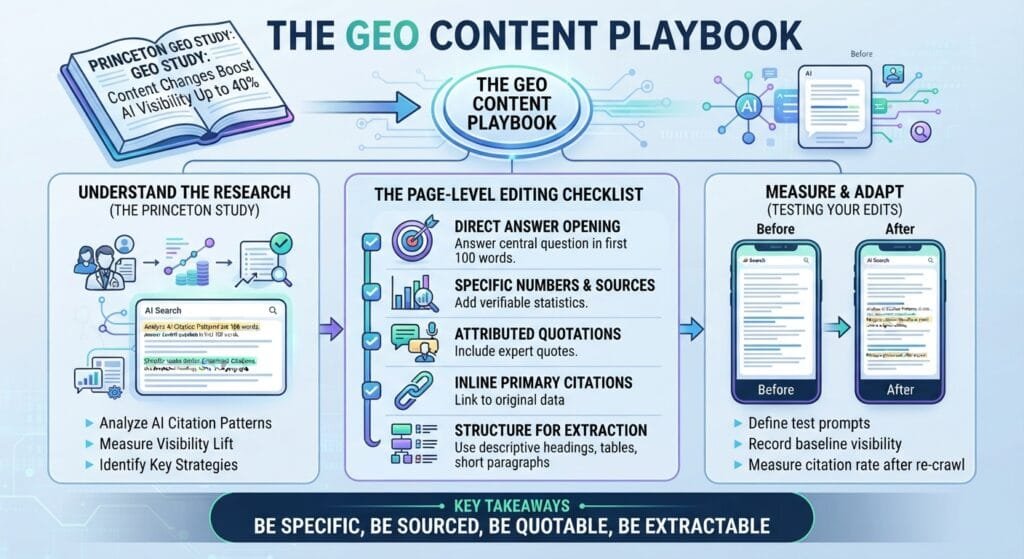

This playbook goes back to the source. It covers what the research measured, where its limits are, and a page-level editing process you can run on your existing content. It also covers the audit signals that sit beneath the content, because a well-written page that AI systems cannot fetch or parse will not be cited.
What the GEO paper actually tested
The paper, “GEO: Generative Engine Optimization” by Aggarwal and colleagues from Princeton, Georgia Tech, the Allen Institute for AI, and IIT Delhi, was presented at ACM SIGKDD 2024 (arXiv). The authors built GEO-bench, a benchmark of roughly 10,000 queries across multiple domains, and simulated a generative engine: retrieve sources for a query, then have a language model write an answer with citations. They then rewrote source content using different strategies and measured how much more visible the source became inside the generated answer.
Their headline claim is that GEO strategies can boost visibility by up to 40%. Two details in the abstract deserve equal attention:
- The strategies were evaluated in a black-box setting. The authors did not need to know how the engine worked internally.
- The efficacy of strategies varies across domains. What works for a health query may not work for a legal or technology query.
The strategies that performed best in the reporting on the paper were the ones that made a page easier to cite: adding statistics, adding quotations from credible sources, and citing sources explicitly. Secondary write-ups also report that the gains were largest for pages that started lower in the retrieved results, with one summary citing a relative visibility increase above 100% for fifth-ranked sources that added citations. Treat that as a directional finding rather than a guarantee.
What the paper does not tell you
Responsible use of the research means knowing its edges.
- The engine was simulated. Real products such as ChatGPT, Perplexity, Gemini, and Google’s AI Mode use different retrieval systems, and they change.
- Visibility is a metric defined by the authors. It measures how prominently a source appears in a generated answer, not whether it drives traffic or revenue.
- The study is from 2023-24 model behaviour. Models and retrieval pipelines have evolved since.
- Domain effects differ. Your own testing on your own topics matters more than an average.
This is why the practical loop is: apply the principle, then measure your own citations, rather than assuming a percentage carries over.
The page-level editing checklist
Take one page at a time. Choose a page that already targets a real question and has some visibility, because improving a page that is close to being cited is easier than rescuing one that is invisible.
1. Rewrite the opening as a direct answer
Within the first 60 to 100 words, state the answer to the page’s central question in plain language. AI systems extract passages, and a self-contained answer near the top is easy to lift. Follow it with the supporting detail.
2. Add specific numbers, with sources
Replace vague claims (“many companies,” “significant growth”) with a figure and its origin (“Pew Research Center found that users clicked a link in 8% of visits with an AI summary versus 15% without”). Name the study, the sample, and the date where you can. This does two things: it gives models a concrete fact to quote, and it signals that your page is grounded.
3. Add attributed quotations
Include short, accurate quotes from named experts, official documentation, or original interviews. Do not fabricate them, and do not attribute paraphrases as quotes. A quote from a primary source that you have verified is a strong trust signal.
4. Cite primary sources inline
Link to the original study, the official doc, or the dataset rather than to another blog summarising it. Inline citations placed next to the claim they support are more useful than a reference list at the bottom.
5. Make every section stand alone
Because engines retrieve passages, each H2 section should make sense if read alone. Restate the subject in the first sentence rather than relying on “as mentioned above.” Keep sections focused on one idea and roughly 100 to 250 words.
6. Structure for extraction
Use descriptive headings that mirror real questions, short paragraphs, and lists or tables where the content is genuinely list-like. Comparison tables are especially citable because they package facts cleanly.
7. Avoid the tactics that do not help
The paper found that classic keyword stuffing did not deliver meaningful gains in its experiments. Padding a page with repeated phrases costs readability and does not earn citations.
The layer beneath the content: is the page eligible at all?
Content edits only matter if the page can be reached and understood. Run through this list before, or alongside, the editing checklist:
- Crawl access. Check
robots.txt. OpenAI documents separate crawlers: OAI-SearchBot is used to surface sites in ChatGPT search, GPTBot is used for training data, and ChatGPT-User fetches pages on behalf of users’ requests (OpenAI). Blocking OAI-SearchBot means your pages will not appear in ChatGPT’s search answers, so decide deliberately. - Indexation. Google states that to be shown as a supporting link in AI Overviews or AI Mode, a page must be indexed and eligible to appear in Search with a snippet (Google Search Central).
- Rendering. If the core content only appears after client-side JavaScript runs, some crawlers may see an empty shell. Serve the main text in the initial HTML.
- Structured data. Google says you do not need special markup for AI features, but accurate schema such as Article, Organization, FAQPage where genuinely applicable, and Product still helps machines interpret a page and supports traditional rich results.
- Authorship and trust signals. Named authors, credentials, an About page, and editorial policies help both readers and systems judge reliability.
Doing this by hand for hundreds of URLs does not scale. A page-level audit tool speeds it up: Vista AI’s Page Audit analyses a page across dimensions including AI crawlability and rendering, schema, content extraction, E-E-A-T signals, and citation potential, and returns scores with prioritised recommendations. That lets you rank fixes by likely impact instead of guessing.
How to test whether your edits worked
A before-and-after test needs a fixed prompt set and patience.
- Pick 10 to 20 prompts the page should answer.
- Record baseline mentions and citations across the assistants you care about, several runs each, because answers vary.
- Publish the edit and make sure the page is re-crawled.
- Re-run the same prompts after two to four weeks.
- Compare citation rate, not just mention rate. A citation of your URL is the strongest signal that the page itself is being used.
Change one thing at a time where you can. If you rewrite the intro, add statistics, and restructure the page all at once, you will not know which change mattered. On a larger site, test on a group of similar pages and hold a comparable group back as a control.
Where third-party mentions fit
A page-level playbook has a ceiling. Ahrefs found that only around 12% of URLs cited by assistants such as ChatGPT, Gemini, and Copilot ranked in Google’s top 10 for the original prompt in its 15,000-prompt sample (Ahrefs), and Semrush’s tracking has shown that the sources engines lean on can shift substantially within weeks (Semrush). Engines draw on forums, reviews, encyclopedias, and news as well as brand sites. Your page-level work should be paired with earning coverage in the places engines already trust.
Adapting the checklist by page type
The same principles apply everywhere, but the emphasis changes with the page.
Guides and how-tos. These are the natural home for direct answers and sourced statistics. Add a short “key takeaways” block near the top, and make each step or section stand alone. Include dates so that freshness is clear.
Comparison and alternatives pages. Buyers ask assistants to compare options, so these pages get used. Build a real comparison table with criteria that matter, state who each option suits, and be honest about limitations. Pages that only praise the publisher’s own product give a model little that is trustworthy to quote.
Product and feature pages. State plainly what the product does, who it is for, and what it costs or how pricing works. Avoid vague superlatives. Assistants are more likely to reuse a plain factual description than a slogan.
Original research and data pages. These are among the strongest assets, because they are a primary source others cite. Publish the methodology and sample size, offer the data in a table, and make the key finding a one-sentence claim near the top.
Case studies. Name the client where permitted, state the starting point, the action, and the measured outcome. Specific numbers with context are more useful than adjectives.
Common editing mistakes
- Adding statistics without sources. A number nobody can trace reduces trust. If you cannot cite it, leave it out.
- Over-optimising the intro. A direct answer is helpful; a wall of keywords is not. Write for the reader first.
- Editing pages that are not indexed. Confirm indexation before spending time on copy.
- Changing dates without changing content. Freshness signals work only when the update is real. Revise the substance, then update the date.
- Measuring too early. Give the change a few weeks to be re-crawled and to appear in answers before you judge it.
How to write a sourced statistic that models can use
Not every statistic helps. A good one has four parts: the claim, the number, the source, and the scope. Compare two versions:
- Weak: “AI is killing clicks.”
- Strong: “In a Pew Research Center analysis of 900 US adults’ browsing, users clicked a traditional result in 8% of visits to a Google results page with an AI summary, versus 15% for pages without one.”
The strong version tells the reader and any model who measured it, how, on whom, and what the finding was. It is also easy to verify, which is what turns a statistic from decoration into evidence. Where you have your own data, apply the same discipline: state the sample, date range, and method in a sentence next to the number.
A one-week sprint
If you want to start small, run this on a single high-value page:
| Day | Task |
|---|---|
| 1 | Define the target question and 10 to 20 test prompts; record baseline |
| 2 | Audit crawl access, indexation, rendering, schema |
| 3 | Rewrite the opening as a direct answer; add sourced statistics |
| 4 | Add verified quotations and inline primary-source citations |
| 5 | Make sections self-contained; tidy headings and tables |
| 6 | Publish, request re-crawl, log the change date |
| 7 | Set the re-test date and calendar it |
Key Takeaways
- Lead each page with a direct answer, then support it with evidence.
- Add statistics and quotations only when you can source them.
- Cite primary sources next to the claims they support.
- Make each section self-contained so passages can be extracted alone.
- Confirm crawl access, indexation, and rendering before editing copy.
- Test on a fixed prompt set and compare citations, not only mentions.
Conclusion
The Princeton study gave the field its first rigorous evidence that how content is written affects how often it is used in AI answers. Its practical message is unglamorous: be specific, be sourced, be quotable, and be easy to extract. Pair those edits with a page that crawlers can reach and parse, then measure your own citations over time. Treat “up to 40%” as a reason to run the experiment, not as a promise.
